Real Estate
Real Estate Builder Platform
Designing a dual-platform ecosystem with a mobile app for property buyers and a web platform for builder teams, transforming post-booking communication across India.
Designing a dual-platform ecosystem with a mobile app for property buyers and a web platform for builder teams, transforming post-booking communication across India.
This case study presents the design process and key decisions. Due to active NDA agreements and ongoing international expansion, detailed screen designs and proprietary implementation details cannot be shared at this time. The platform is being adapted for new markets beyond India.
This project transformed real estate customer communication in India from fragmented human coordination into a structured, scalable digital system. The platform digitized construction progress tracking, financial management, document handling, and multi-stakeholder communication into a single ecosystem serving both property buyers and builder teams.
Fragmented post-booking communication causing anxiety for buyers and operational overload for builders.
Dual-platform ecosystem with mobile app for buyers and web platform for builder teams.
Service design thinking to map complete ecosystem and redesign information flow.
Led team of 5 product designers through discovery, concepting, design, and delivery.
Real property buyers across 3 companies validated the solution through structured testing.
System-level thinking beyond screens, redesigning how stakeholders coordinate.
The platform launched with 5 pilot builders and scaled to 300+ builders across India, transforming the industry standard for real estate customer communication.
Reduced average document request cycles from 5 rounds to 1.5, dramatically improving efficiency.
Set a new benchmark for real estate communication across India's builder ecosystem.
As Creative Lead, I directed the entire design vision for this project with a team of 5 product designers. My responsibilities went beyond traditional product design to encompass service design thinking, strategic decision-making, and cross-functional leadership.
Led service design thinking that connected fragmented touchpoints into a cohesive system. Made critical decisions on information architecture and multi-role interaction patterns.
Conducted stakeholder interviews across buyer personas, sales, construction, and finance teams. Synthesized insights into actionable design principles.
Directed team of 5 designers through discovery, concepting, design, and delivery phases. Established design standards and review processes.
Mapped entire service ecosystem showing information flow between stakeholders. Identified where human coordination failed and technology could intervene.
Designed both mobile experience for buyers and web platform for builder teams. Ensured seamless information flow between platforms.
Created white-label architecture and modular design system enabling scale to 300+ builders without compromising quality.
In India’s real estate market, property buyers make significant financial commitments early, often before construction begins. But after booking, the experience becomes fragmented and anxiety-inducing.
The industry had a toxic pattern where once builders received payment, customer service often deteriorated. Buyers felt ignored and powerless. Communication became sporadic. Updates disappeared. The “paid and forgotten” problem was real and widespread.
No visibility into construction progress. Documents scattered across emails. Payment schedules unclear. Constant follow-ups via calls and WhatsApp. No idea who to contact for what. High anxiety about investment.
Constant inbound status questions. Repeated explanations of same information. Manual document sharing via email. Miscommunication eroding trust. Scaling communication became bottleneck. High operational costs.
The real problem was not lack of information. The problem was lack of a shared, structured system that could coordinate multiple stakeholders across a long-running, high-value transaction. Core insight from stakeholder research
Create a premium, easy-to-use mobile app that acts as a digital companion for the buyer and a coordination platform for the builder.
Shared foundation serving different stakeholder needs through role-based views.
Show status through visual indicators rather than lengthy explanations.
Enable users to find answers themselves, reducing dependency on human coordination.
Clear communication and progress visibility create confidence in long-running purchases.
Structured status indicators replace unstructured text updates.
I led comprehensive research across multiple stakeholder groups, conducting in-depth interviews with property buyers, sales teams, construction managers, finance teams, and project managers across 5 real estate companies.
45+ interviews across buyers, sales, civil, finance, and management teams to understand the full ecosystem.
Mapped complete post-booking lifecycle from buyer and builder perspectives, identifying critical friction points at each stage.
Observed real communication flows via WhatsApp, calls, emails, and site visits to understand actual behavior patterns.
Buyers didn’t need persuasion, they needed visibility. Information existed but was fragmented across channels.
Teams spent 60%+ of time answering repetitive questions. Trust erosion happened through inconsistent communication.
Photos of progress mattered more than text updates. Buyers wanted clear ownership of who to contact for what.
Buyers didn’t need persuasion, they needed visibility. They had already made their purchase decision. What they needed now was confidence that their investment was progressing as promised. Key insight from buyer interviews
Before designing screens, I created a comprehensive service blueprint to map the entire ecosystem. This revealed critical friction points and guided our solution design.
| Journey Layer | Onboarding Day 1-7 |
Construction Month 1-15 |
Financials Ongoing |
Documents Ongoing |
Inspection Month 16-17 |
Pre-Handover Month 17-18 |
Post-Handover Month 18+ |
|---|---|---|---|---|---|---|---|
| Physical Evidence |
Mobile app download & welcome screens
Welcome email with credentials
|
Weekly site photos in app gallery
Timeline with progress indicators
|
Payment dashboard & schedule
Digital receipts (PDF)
|
Document library with search
Status badges (Pending/Approved)
|
Digital inspection checklist
Snag list with photo upload
|
Completion certificate & possession letter
Digital welcome kit & guides
|
Warranty portal & claims
Community & referral features
|
| Customer Actions |
Receives SMS, downloads app, creates account 15 mins
Explores dashboard, views property details & timeline 20 mins
|
Weekly check-ins to view photos & progress updates 10 min/week
Messages civil team with questions about timeline
|
Receives payment reminder for ₹12L milestone Day -7
Transfers payment, uploads proof, receives receipt
|
Receives request for Aadhar & PAN documents
Uploads via camera, checks approval status 10 mins
|
Books inspection slot through app
Conducts walkthrough, reports 5 snags 45 mins
|
Makes final payment ₹8.5L 1 week before
Reviews documents, confirms handover date
|
Reports kitchen cabinet hinge issue with photo
Shares referral link with 3 colleagues
|
| Frontstage Actions |
Sales: Welcome call, guides through app setup
Sales: Sends onboarding email with screenshots
|
Civil: Uploads weekly site photos with captions
Civil: Responds to queries within 24 hours
|
Finance: Sends reminder with payment details
Finance: Confirms payment, generates receipt
|
Sales: Requests documents with deadline
Admin: Reviews & approves documents
|
PM: Confirms appointment, sends access details
Civil: Updates snag status with fix photos
|
Finance: Confirms final payment, closes account
PM: Conducts handover ceremony
|
Admin: Schedules maintenance visit
Sales: Tracks referrals, processes rewards
|
| Backstage Actions |
IT: Creates account, assigns permissions
Admin: Imports property & payment data
|
Civil: Quality checks before marking milestones
IT: Compresses images, generates thumbnails
|
Finance: Reconciles bank transfer with booking
Finance: Updates ERP, files tax returns
|
Admin: Verifies document authenticity
Legal: Drafts sale deed, gets signatures
|
Civil: Routes snags to contractors
PM: Verifies all snags resolved
|
Finance: Verifies payments, closes account
Admin: Prepares keys, kit, warranty cards
|
Admin: Assigns technician, schedules repair
Sales: Calculates referral rewards
|
| Support Systems |
CRM system, authentication, SMS/email gateway
|
Cloud storage (AWS), image processing, push notifications
|
Payment gateway, ERP integration, receipt generator
|
Document management, OCR, encryption, audit logs
|
Workflow engine, snag tracking, vendor management
|
Calendar system, e-signature (DocuSign), compliance checker
|
Warranty tracking, ticketing (Zendesk), referral engine
|
The service blueprint revealed 5 major friction points that shaped our entire design approach.
Sales, civil, and finance teams used separate systems. When buyers asked questions, teams gave conflicting information because they weren’t working from the same source of truth.
Solution: Single shared database with role-based views for all teams.
Civil teams were expected to share progress photos, but the process involved taking photos, transferring to computer, uploading to server, and emailing buyers. This 4-step process meant photos were rarely shared.
Solution: Direct mobile upload from construction site.
Finance team requested payments, but buyers couldn’t verify if milestones were actually completed. This created distrust and payment delays.
Solution: Payment reminders linked to milestone completion proof.
Document requests happened across 5 different emails over 3 months. Buyers lost track of which documents were pending, approved, or rejected.
Solution: Centralized document library with status tracking.
After inspection, buyers reported issues but never knew if they were fixed, who was working on them, or when they’d be resolved. This created anxiety right before handover.
Solution: Digital snag tracking with photo updates and status.
Instead of jumping to wireframes, the service blueprint helped us identify where technology should intervene vs where human coordination should remain. It revealed that the real problem wasn’t lack of features. It was lack of information flow between stakeholders. This insight shaped every design decision that followed.
Based on the blueprint discoveries, I designed a complete service ecosystem connecting property buyers, sales teams, civil engineers, finance teams, project managers, and admin staff. Each role needed different capabilities while working from the same shared foundation.
Progress visibility, clear communication, payment tracking, document access, and confidence in their investment via mobile app for on-the-go access.
Buyer overview, communication management, document handling, and onboarding coordination via web dashboard for desk-based work.
Progress updates, photo uploads, payment tracking, milestone management, and status reporting via web dashboard optimized for bulk operations.
These architectural decisions directly addressed the problems revealed by the service blueprint:
All data flows into one system. Updates propagate automatically. No information exists outside the platform. This eliminated duplicate entry and inconsistent communication.
Different stakeholders see different views of the same data. Buyers see simplified information. Teams see technical details. Everyone works from the same foundation.
Messages tied to specific contexts (construction, finance, or general). Automatic routing to right team. Permanent, searchable record created.
Instead of free-form text, system uses status indicators, progress markers, and structured inputs. Reduces cognitive load and ensures consistency.
Every feature designed to answer questions buyers would otherwise call about. If users can self-serve, call volume drops and satisfaction increases.
Mobile app for buyers, web platform for builders. Information flows seamlessly between platforms without manual coordination.
The solution centered on a mobile-first platform for buyers paired with a web platform for builder teams. Each platform served its audience while maintaining a shared data foundation.
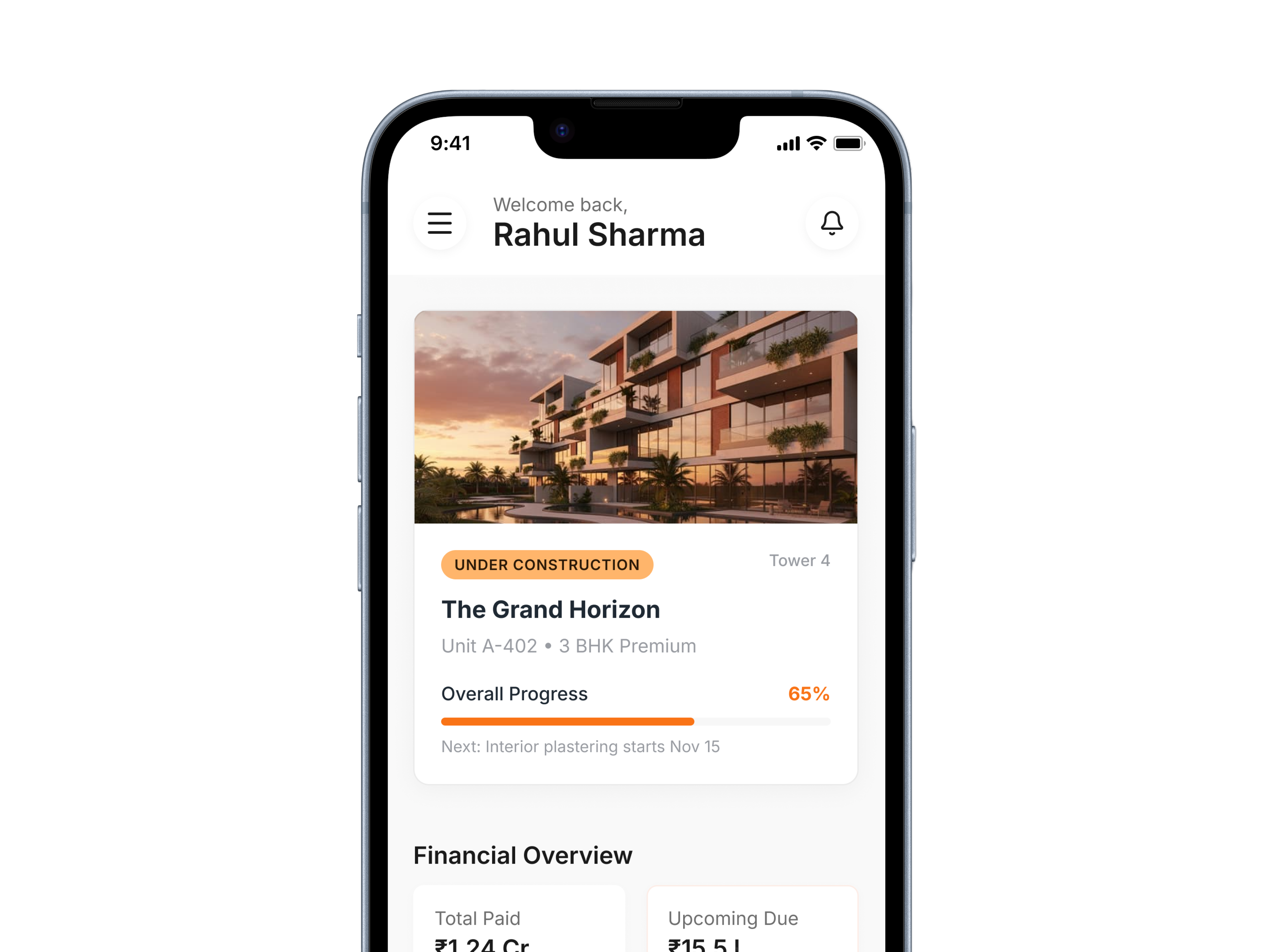
Single entry point showing property summary, construction progress, financial status, pending actions, latest updates, and quick access to all modules.
Monthly milestone timeline, weekly photo updates, categorized stages with plain-language explanations, materials used, status indicators, and complete history.
Payment schedules, paid vs pending amounts, receipts, secure document upload/download, status tracking, and loan stage tracking with next steps.
Role-based messaging to Sales, Civil, Loan, or Project Manager. Messages automatically route to right team with complete history and file sharing.
Project overview, amenities, floor plans, unit details, downloadable brochures, and discovery of other projects.
Proactive updates for construction progress, payment reminders, document requests, and announcements with configurable preferences.
Beyond the mobile app for buyers, I designed a comprehensive web experience for builder teams. This platform served sales, finance, and civil teams from their work computers, acting as the operational backbone that powered the customer-facing app.
Civil teams could upload photos, update milestone status, add descriptions, and schedule updates directly from computers. Optimized for slow network conditions with progress indicators and resume capabilities.
Finance and sales teams could upload contracts, receipts, NOCs, and documents with automatic buyer notifications. Secure storage with version control and audit trails.
Finance teams managed payment schedules, recorded transactions, generated receipts, and tracked loan stages with complete financial visibility.
All teams could view and respond to buyer messages with clear department-based routing. Complete communication history and context available at a glance.
Sales and project managers could see unified view of each buyer’s journey including construction status, payment status, pending actions, and communication history in one place.
Teams could send announcements, schedule updates for multiple units, and manage data efficiently. Role-based permissions ensured teams only accessed relevant information.
This dual-platform approach created a complete ecosystem where information flowed seamlessly between stakeholders without manual coordination. Core design philosophy
After designing the initial solution, we presented the mobile and web prototypes to builder-side teams including sales managers, project managers, civil engineers, and finance teams. Their feedback revealed critical pain points we hadn’t anticipated.
Pain Point: Civil engineers found the photo upload process too cumbersome. They needed to update progress for multiple units at once, but the design required unit-by-unit uploads.
Revised: Added bulk upload capabilities where engineers could select multiple units and upload progress photos in one flow, reducing a 30-minute task to under 5 minutes.
Pain Point: Business owners wanted a single-click view of their entire operation including sales completed, complaints (daily count and resolved), site visits, interest forms, and civil work progress across all projects.
Revised: Designed an executive dashboard with high-level KPIs. Owners could see business health at a glance and drill down when needed. This feature became critical for owner adoption.
The revised solution addressed operational realities we only understood after presenting to the people who would use the system daily. This iteration phase transformed a good design into a practical, scalable product. Post-iteration reflection
Scaling to 300+ builders required solving complex design challenges including diverse user demographics, varying expectations, and white-label architecture. The design system needed to be flexible yet consistent, accessible yet powerful.
Property buyers ranged from tech-savvy millennials to older buyers in their 50s and 60s making their first major property investment. Financial status varied widely, from first-time homebuyers to seasoned investors, creating different interaction expectations and digital literacy levels.
Older buyers (50-65 age group) needed larger touch targets, clearer visual hierarchy, and simpler navigation. Younger buyers wanted quick access and efficiency.
Solution: Designed with 48px minimum touch targets, high contrast ratios (WCAG AA compliant), and progressive disclosure that stays simple at first glance yet detailed when needed.
Some buyers were comfortable with complex apps while others struggled with basic smartphone navigation. Language preference varied between English, Hindi, and regional languages.
Solution: Icon-heavy interface with minimal text, tooltips on first use, and multi-language support. Every action had a clear visual outcome.
Higher-income buyers expected sophistication and detail. First-time buyers needed reassurance and guidance. Both groups wanted control.
Solution: Layered information architecture. Summary view for confidence, detail view for control. Onboarding tailored based on user behavior patterns.
Business owners needed to stay aligned without micromanaging. The dashboard provided instant visibility into operations.
Units sold today, this week, this month with trend indicators.
Active complaints, resolved today, pending resolution with aging indicators.
Site visits scheduled, interest forms filled, app adoption rate.
Civil work completion across all projects with photo evidence.
Payments received, pending payments, milestone completion rates.
Response times, update frequency, buyer satisfaction by project.
Core components shared across all builder instances. Configurable branding (colors, logos, typography). Builder-specific data isolation. Modules can be enabled or disabled per builder. Consistent interaction patterns across versions. Atomic design methodology for component reusability.
WCAG AA compliant color contrast and text sizing. Screen reader support and keyboard navigation. Offline-first architecture for unreliable networks. Optimized for 2G/3G network speeds. Lightweight assets with progressive image loading. Simple, familiar interaction patterns for low digital literacy.
We initially tested the working prototype with 2 pilot builders representing different market segments (one mid-tier builder and one premium builder). This allowed us to observe real usage patterns with actual property buyers and builder teams before scaling.
Deployed working mobile app and web dashboard with 2 builders covering ~80 active property buyers. Conducted contextual inquiry, watching buyers and teams use the system in real scenarios.
Duration: 6 weeks of monitored usage
Data Collected: Usage analytics, support tickets, direct observation, and structured interviews
Based on pilot findings, we refined critical flows, simplified complex interactions, and addressed edge cases. Then scaled to 3 additional builders for validation testing.
Duration: 4 weeks iteration + 8 weeks validation
Outcome: Validated solution ready for white-label deployment
Buyers appreciated summaries first with ability to drill down. Too much information upfront caused anxiety rather than confidence. Dashboard view was checked 3-4x more frequently than detail views.
Construction updates with photos received 3x more engagement than text-only updates. Visual proof was essential for building trust. Buyers shared construction photos with family members as progress validation.
Too many notifications caused app uninstalls. Too few caused missed updates. We refined to milestone-based notifications only (payment due, construction milestone complete, document ready for signature).
Knowing exactly who to contact for what issue significantly reduced buyer stress. Role-based messaging became the most valued feature, reducing call volume by 65%.
Technical construction terms confused users. We iterated to plain language like “Foundation work complete” instead of “Plinth level achieved.” This simple change increased update comprehension from 60% to 95%.
When owners could see complaint resolution metrics, response times improved dramatically. Visibility created accountability without micromanagement.
This project taught me invaluable lessons about service design, system thinking, and designing for trust.
Individual features solve isolated problems. Systems redesign how work gets done. The biggest impact came from rethinking information flow, not adding screens.
For high-value, long-running purchases, users need transparency over persuasion. They’ve already committed. Now they need confidence.
Designing for multiple user types isn’t about separate interfaces. It’s about understanding how roles interconnect and designing a shared system.
White-label architecture and modular design systems enabled rapid scaling without compromising quality or consistency.
As Creative Lead, I made decisions balancing user needs, business constraints, technical feasibility, and long-term scalability. Clear principles guided consistent choices.
This project demonstrated that impactful design redesigns services, relationships, and how people work together.

The Real Estate Builder Platform transformed from a feature request into a platform that redefined an entire industry’s approach to customer communication. By focusing on service design, multi-stakeholder coordination, and trust through transparency, we created a system that scaled to 300+ builders and became the industry standard.
After pilot testing and refinement, we built production-ready mobile and web applications. The initial rollout with 5 builders proved the model. Success metrics (65% call reduction, 40% satisfaction increase) convinced leadership to invest in white-label infrastructure. Within 18 months, we scaled to 300+ builders across India.
The platform’s unexpected impact came from empowering business owners. The executive dashboard gave them real-time visibility into operations, creating accountability without micromanagement. Owners reported feeling more in control of their business than ever before. They could see problems emerging (complaint resolution slowing down, civil work falling behind schedule) and address them proactively.
Before, I’d only know about problems when buyers called me directly, furious. Now I see issues the same day they happen. My team knows I’m watching, so they stay on top of it. The platform didn’t just help buyers. It transformed how I run my business. Feedback from a builder owner
This project stands as evidence that design thinking, when applied at the service level, can transform entire ecosystems, not just individual products. It validated my belief that the best design solutions come from deeply understanding the system, not just the screens.
Get in touch to discuss projects and opportunities.